
As we move deeper into 2026, the data center industry sits at a volatile intersection of limitless demand and physical reality. While the artificial intelligence boom continues to drive unprecedented construction, the sector faces growing friction from power grids, local communities, and supply chains.
Based on recent market activity and industry reports, here are the four critical trends defining the data center landscape in 2026.
1. The Energy Crisis Hits Home (Literally)
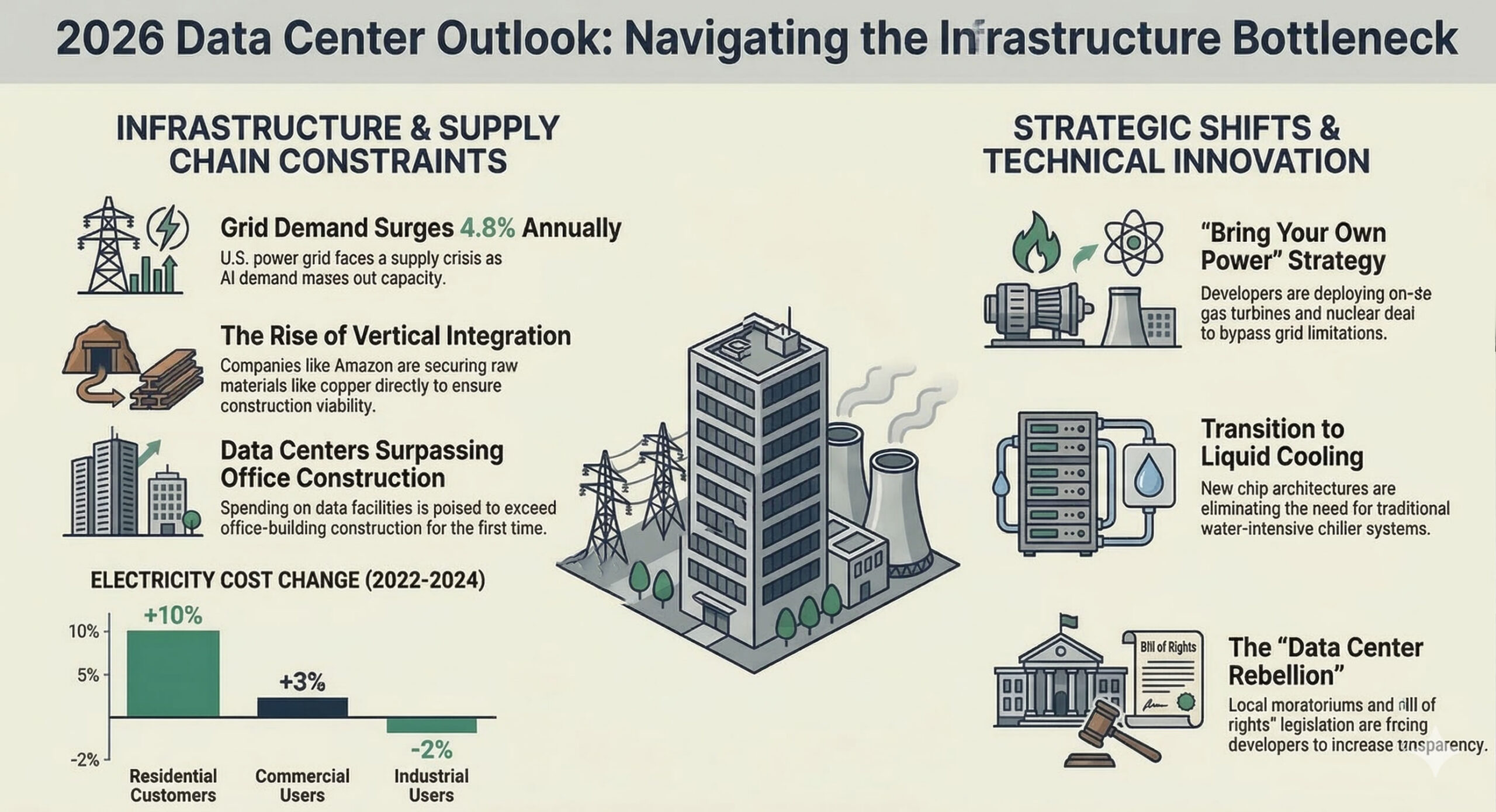
The most immediate challenge in 2026 is the sheer inability of the U.S. power grid to keep up with AI’s appetite. The strain is most visible in regions like PJM Interconnection (serving 13 states including Virginia’s “Data Center Alley”), where reliability risks have moved from “on the horizon” to “across the street”.
- Consumer Costs are Spiking: Residential electricity prices have surged, creating a political flashpoint. In Washington D.C., costs jumped 93% over five years, and in New Jersey, rates spiked 20% in June 2025 alone. This has led to accusations that residents are subsidizing Big Tech’s power bill.
- Tech Giants Pledge to “Pay Their Way”: Facing political pressure, companies like Microsoft have pledged to cover their own electricity costs to avoid burdening ratepayers.
- Going Off-Grid: To bypass grid constraints, developers are effectively building their own power plants. We are seeing a surge in on-site generation, with companies buying natural gas generators from manufacturers like Caterpillar, whose power segment is now its fastest-growing business.
2. The Nuclear and Copper Renaissance
To solve the energy puzzle, the industry is reviving old technologies and securing raw materials directly at the source.
- Nuclear Deals: 2026 is seeing a wave of nuclear power purchase agreements. Meta recently signed deals to buy power from Vistra Energy’s nuclear plants in Ohio and Pennsylvania, while Amazon has partnered with Talen Energy for nuclear power in Pennsylvania.
- Vertical Integration: Tech giants are channeling Henry Ford by securing their supply chains from the ground up. Amazon recently signed a deal with Rio Tinto to secure copper from a mine in Arizona—the first new U.S. copper output in over a decade—acknowledging that AI factories cannot function without the physical wiring to conduct electricity.
3. The “Data Center Rebellion”
A “Not In My Backyard” (NIMBY) movement has gone national. What was once a quiet zoning process has turned into a “data center rebellion” reshaping local politics.
- Moratoriums and Bans: Communities from Northville, Michigan to St. Charles, Missouri, are enacting moratoriums or rejecting projects outright due to concerns over noise, water usage, and aesthetics. In 2025 alone, billions of dollars in planned development were derailed by local opposition.
- Legislative Guardrails: States like Wisconsin and Georgia are debating or passing legislation to protect ratepayers and strictly regulate water usage, requiring “closed-loop” cooling systems to prevent aquifer depletion.
4. Innovation vs. Obsolescence
As the physical footprint faces pushback, the technology inside the box is evolving rapidly to survive.
- Liquid Cooling is Standard: With chip density increasing, air cooling is becoming obsolete. Vertiv predicts that “adaptive liquid cooling” will shape all future designs, and Nvidia’s CEO has stated that upcoming chip generations may eliminate the need for water chillers entirely.
- The On-Device Threat: While construction booms, a counter-trend is emerging. Perplexity CEO Aravind Srinivas warned in early 2026 that the biggest threat to data centers is “on-device AI,” where processing happens locally on phones and laptops, potentially rendering massive centralized server farms less critical over time.
The Bottom Line for Investors
2026 is viewed as a “make-or-break” year for the AI trade. While spending on data center construction is poised to surpass office building construction for the first time, the risks are compounding. Investors are navigating a landscape where physical constraints (power, land, copper) and social license (community acceptance) matter just as much as the algorithms running on the servers.For a deeper breakdown of the infrastructure layers, power dynamics, cooling technologies, and geographic exposure shaping this cycle, explore our full Data Center Compendium.