

Available Now: Cybersecurity Market Trends


Cybersecurity Is Consolidating and the Strategic Winners Are Emerging
The enterprise cybersecurity stack is being redefined. What used to be a fragmented patchwork of point solutions is now rapidly converging into full-scale platforms. It’s built on zero-trust principles, powered by AI-native SOCs, and increasingly governed by identity and telemetry rather than firewalls and VPNs.
At SeventhBiz, we just released our 2025 Cybersecurity Market Trends on the cybersecurity market—a deep, competitive report that evaluates where the sector is headed and which public vendors are best positioned to capture value over the next cycle.
Why Now?
Between regulatory pressure, cloud migration, remote work, and the explosion of threat surfaces, cybersecurity has shifted from a reactive IT function to a strategic control layer. Boards are funding it, CISOs are consolidating it, and public vendors are racing to own the entire operational perimeter. But not all are competing on the same terms.
Some vendors are building broad, integrated platforms (Palo Alto Networks, CrowdStrike). Others are defining new architectures from within (Zscaler, Okta, Cloudflare). While some are doubling down on specialized plays in edge security, identity, or managed response.
Our new report captures this shifting landscape through structured, grounded analysis based entirely on public company disclosures.
From these sources, we extract the themes that matter—platform consolidation, SOC automation, identity-first architectures—and map them against disclosed revenue figures, segment strategies, and growth narratives.
The result is a report showing you the most influential companies actively reshaping the cybersecurity market.
Inside the Report:
Strategic themes: AI-native security operations, extended detection and response (XDR), and the consolidation of network, endpoint, and identity into unified platforms
Segmentation models: How vendors organize their platforms — and how buyers are shifting their procurement logic accordingly
TAM estimates for 2025: Directly sourced from vendor disclosures, broken down by segment (e.g., endpoint, cloud, identity, log analytics)
Company profiles: Narrative assessments and SWOTs for nine public vendors, including Palo Alto Networks, CrowdStrike, Fortinet, Zscaler, SentinelOne, Okta, Cloudflare, Rapid7, and Akamai
Informational visuals: A proprietary competitive landscape chart visualizing each company’s position based on execution strength and platform expansion readiness
Ready to Dive In?
The full 2025 Cybersecurity Market Trends Report is now available as a standalone report. If you’re ready to see how leading public vendors are repositioning around platform consolidation, AI-native operations, and zero trust control layers, this is the place to start.
Available Now: Fintech Infrastructure & Payments Market Trends

The Fintech Stack Is Splitting — Who’s Building the Rails?
Explore the 2025 Fintech Industry Report, a full-length strategic briefing designed to map how public fintech companies are scaling payments infrastructure, AI underwriting, and cross-border money movement in a rapidly fragmenting financial ecosystem.
This fintech market research report is tailored for investors in fintech, strategy teams, and operators who want to stay ahead of the curve as the industry shifts from standalone apps to embedded infrastructure. It’s packed with insights into fintech investment opportunities and the latest fintech market trends driving innovation and competition.
Inside the Report:
Strategic breakdowns of five core trend clusters, including real-time payments, embedded finance, and AI-powered lending
Company profiles for 12 public fintech leaders — from Visa and Mastercard to Affirm, Block, and Toast
Exact revenue and TAM data sourced directly from investor materials (10-Ks, earnings calls, and presentations)
SWOT analysis for each platform and a strategic positioning matrix mapping product breadth vs. platform scope
Valuation benchmarking including public comps for key players in fintech
This report provides the data and analysis you need to act with confidence while navigating the changing fintech industry, tracking the next wave of disruption, and evaluating new fintech investment opportunities.
The Pitfalls of Investment Reports: What I Learned as a Wealth Manager


During my career in banking and wealth management, I quickly discovered a painful truth: most investment reports were hard to digest, overly technical, and, often, not actionable. This posed a real challenge. While the data was often accurate and the insights valuable, the reports themselves were cumbersome and not designed with clarity or action in mind. Over time, I recognized a critical need to transform how these reports were created and consumed. Here’s what I learned from my experience:
1. Written by Industry Experts, But Not Always for the Business Community
Investment reports are typically written by industry experts who have an in-depth understanding of their subject matter. The problem? These experts often write for a broad, general audience rather than considering the specific needs of the business and investment communities. The result? The information, while accurate, may not be actionable. Investors and decision-makers need to understand how to apply that knowledge to real-world scenarios—not just absorb an academic discourse.
A well-designed report should enable a busy professional to scan it in just a few minutes and dive deeper into specifics only when necessary.
In my years at UBS, I saw how critical it was for reports to provide not only insightful analysis but also to distill that information into clear, actionable takeaways. When creating reports, it’s not enough for the information to simply be accurate—it also needs to be clear and practical in use. By combining industry expertise with thoughtful communication design, SeventhBiz ensures that even complex data is presented in a way that’s easy to understand and apply. This approach makes it possible for the end user to quickly grasp key insights, without being overwhelmed by technical jargon or unnecessary detail, allowing them to make informed decisions more efficiently.
2. Lengthy, Tedious, and Often Skipped
If you’ve ever tried to read a traditional investment report, you’ll know the feeling. It’s page after page of dense text, filled with complex jargon and detailed analysis. I’ve sat in meetings where my clients would glance through these reports, skimming for key takeaways, only to leave feeling overwhelmed or still unclear on how to proceed. Very few people read these reports cover to cover—and for good reason. The volume of information can be paralyzing.
I recall how frustrating it was to navigate through lengthy, dense reports while managing portfolios. Instead of being a helpful resource, they often felt like a barrier. That’s why we focus on structuring reports to be easily digestible. The goal is to allow the reader to quickly grasp the key takeaways and, when needed, explore more detailed analysis. A well-designed report should enable a busy professional to scan it in just a few minutes and dive deeper into specifics only when necessary.
While AI is fantastic for handling large volumes of data, it can’t replicate the care and strategic insight that only comes from a person who deeply understands both the data and the stakes.
3. The Rise of the Robots: Efficiency vs. Human Insight
Thankfully, AI wasn’t around to the extent it is now when I was in financial services, but in recent years, I’ve noticed the rise of AI-driven “expert” articles flooding the market. These reports, generated by algorithms and data-crunching systems, may be quick and efficient—but they lack the human nuance and understanding that an experienced researcher can provide. AI can quickly sift through data and generate insights, but it doesn’t understand the gravity of the decisions being made by investors. When millions of dollars—and, sometimes, years of hard work—are at stake, there is no substitute for human expertise.
That’s where research librarians come in. These professionals don’t just gather and process data—they understand the context, the nuances, and the broader picture. Research librarians play a crucial role in transforming raw data into meaningful insights. By applying their expertise, they are able to curate and analyze complex data, ensuring that the final result is both accurate and relevant to the decisions at hand.
While AI is fantastic for handling large volumes of data, it can’t replicate the care and strategic insight that only comes from a person who deeply understands both the data and the stakes. As noted in research comparing AI-led versus human-led research, AI can often result in hallucinations—producing inaccurate or fabricated information that could mislead decision-makers. Similarly, studies on AI-driven content production highlight the risk of “bullshitting”—where AI generates seemingly authoritative but ultimately unreliable or shallow insights. These shortcomings emphasize the need for human oversight in critical decision-making processes.
The Takeaway
Our time is always of the essence. Reports must be precise, clear, and actionable. I experienced first-hand how frustrating it could be to work with reports that were either too complex or too vague. While technology, including AI, plays an important role in making the research process more efficient, it cannot replace the need for expert insight, nuance, and human judgment in the creation of reports.
Investing in the Future of AI-Driven Data Centers


From the cloud services we rely on daily to the AI algorithms personalizing our digital experiences, AI-driven data centers are quickly becoming the cornerstone of modern infrastructure. With the U.S. data center market valued at over $80 billion in 2024 and growing at an impressive 10% CAGR, it’s no surprise that key players in data centers like Meta, Microsoft, and Amazon are investing billions to stay ahead.
Take Meta’s ambitious $10 billion Sucré project in Louisiana—a massive facility designed to power its Llama 4 AI model. This endeavor shines a spotlight on the growing intersection of AI, energy consumption, and cloud computing data centers. But what does this mean for investors in AI? How will it shape the future of data storage market trends?
Why Investors Should Care: Opportunities in the AI-Driven Data Center Boom
The race to dominate AI and cloud computing is heating up. For investors in AI, Meta’s Sucré is only the tip of the iceberg. Microsoft plans to invest $80 billion in cloud computing data centers this year alone, while Amazon is committing $100 billion over the next decade. These bold moves signal a wealth of data center investment opportunities, especially for those focused on sustainable, energy-efficient solutions.
What’s particularly exciting is the new wave of strategic partnerships. Energy giants like Chevron are teaming up with tech leaders to develop AI-driven data centers adjacent to natural gas fields. This smart strategy bypasses lengthy permitting processes, accelerating construction timelines. For investors, these collaborations are not just interesting—they’re game-changers in shaping data storage market trends.
Beyond the Servers: What and Who You Need to Keep an Eye On
As the industry evolves at breakneck speed, here are two key factors investors should keep on their radar:
Energy Innovations: With energy consumption becoming a critical challenge, breakthroughs in green energy and nuclear solutions will define the winners in this space.
Strategic Collaborations: Expect more partnerships between tech firms and energy providers, creating new avenues for data center investment opportunities.
The Big Picture: Balancing Growth, Energy, and Sustainability
The AI revolution isn’t slowing down, and AI-driven data centers will remain the heartbeat of this transformation. Energy challenges might persist, but they also pave the way for groundbreaking innovation and investment opportunities. The real question is: how will key players in data centers balance rapid growth with energy efficiency and sustainability?
For those eager to dive deeper, our latest data center market research report, Data Centers in the AI Era: Navigating Growth, Energy Challenges, and Digital Transformation, offers comprehensive insights into data storage market trends, energy solutions, and emerging opportunities. Download it today and stay ahead in this ever-evolving industry.
Available Now: Data Centers in the AI Era Market Analysis
From the cloud services that fuel our workdays to the algorithms that personalize our digital experiences, AI-driven data centers are the unseen force driving modern innovation. As AI adoption accelerates across industries, the infrastructure supporting it is evolving at an unprecedented pace. But what does this transformation mean for businesses, investors in AI, and technology providers?
Our latest data center market research report, “Data Centers in the AI Era,” takes an in-depth look at the rapidly growing U.S. data center market—valued at over $80 billion in 2024—and the trends shaping its future. With an estimated 10% CAGR, demand for data storage market trends and cloud computing data centers is skyrocketing, making data centers one of the most dynamic data center investment opportunities in the digital economy.
What You’ll Find in the Report

Data Center Growth Trends → Key drivers behind the data center boom, from cloud computing to AI workloads.

Key Players in Data Centers → The companies shaping the next generation of digital infrastructure.

Data Center Investment Landscape → The opportunities and challenges facing data center development.

Data Center Energy Challenges → How the industry is balancing demand with environmental concerns.
Secure Your Competitive Advantage
AI’s insatiable need for computational power is reshaping data center infrastructure trends, energy consumption, and network architecture. Understanding these shifts is crucial for businesses leveraging AI, investors in AI data centers, and tech providers building the next generation of infrastructure.
Ready to explore the data backbone of the AI era? Download the full report today to gain a comprehensive view of this high-growth sector.
Previewing Key Market Industries for 2025 Investors

As we step into 2025, the investment landscape continues to be shaped by rapid technological advancements, shifting market demands, and emerging global challenges. Market industry reports for 2025 highlight significant opportunities for investors across key sectors. Below is a look at the industries poised for growth and transformation and insights into their potential opportunities.
Investment Markets to Watch in 2025
Data Centers: Scaling Up for the Digital Economy
As the data-driven economy grows, data centers are at the forefront of technological evolution. Market industry reports show that with AI workloads increasing, the industry is shifting toward green and modular data centers powered by renewable energy. Edge computing continues to rise, driven by the need for real-time data processing closer to users.
Green Data Centers on the Rise: The transition to renewable energy-powered and modular data centers presents attractive investment opportunities for sustainability-focused VCs.
Cybersecurity: Defending the Digital Frontier
With the surge in cyber threats, businesses are turning to innovative security solutions to protect critical infrastructure and sensitive data. According to business research analysis, AI integration into cybersecurity systems enables rapid, real-time threat detection and response. Zero-trust architectures are gaining traction as companies prioritize robust security frameworks.
Increased Demand in Critical Sectors: Rising cyber threats in healthcare, finance, and government spur VC interest in sector-specific cybersecurity solutions.
Solar Industry: Driving Renewable Energy Innovation
The solar energy sector is poised for accelerated growth in 2025, fueled by breakthroughs in panel efficiency and energy storage. Community solar projects are on the rise, making renewable energy more accessible to residential and commercial markets. Business industry research shows that governments worldwide are driving adoption through supportive policies and incentives.
According to the EIA, solar will continue to drive the growth of US power generation through 2026. They “expect U.S. utilities and independent power producers will add 26 gigawatts (GW) of solar capacity to the U.S. electric power sector in 2025 and 22 GW in 2026. Last year, the electric power sector added a record 37 GW of solar power capacity to the electric power sector, almost double 2023 solar capacity additions.”
Energy Storage Innovation: Enhanced battery technologies integrated with solar systems are becoming a key focus area for venture capital funding.
Digital Twin: Revolutionizing Real-World Applications
Digital twin is reshaping industries by providing virtual models of physical systems. These replicas enable predictive maintenance, efficient urban planning, and patient-specific healthcare solutions. State of the industry reports reveal that this technology is unlocking new efficiencies across manufacturing, healthcare, and smart city development.
What is a Digital Twin?
A digital twin in manufacturing is a virtual replica of a physical object, process, or system that is used to simulate, monitor, and optimize performance in real time. It integrates data from sensors, machines, and systems in the physical world with advanced analytics, AI, and simulations in the digital world.
For example, in a manufacturing environment, a digital twin can represent a production line or machine, allowing operators to analyze operations, predict equipment failures, optimize workflows, and improve efficiency without disrupting the actual production process. It bridges the physical and digital realms, enabling better decision-making and performance improvement.
Strategic Partnerships: Collaborations between startups and large enterprises are accelerating the adoption of digital twin platforms, attracting VC interest.
Cold Chain Logistics: Meeting the Demand for Precision Delivery
The growing need for temperature-sensitive goods is driving advancements in cold chain logistics. IoT and blockchain technologies are improving transparency and efficiency across the supply chain. Consumer insights highlight the pharmaceutical industry as a key growth driver, where precise cold storage is critical for biologics and vaccines.
Pharma Demand Boosts Growth: Increasing biologics and vaccine distribution is creating opportunities for VCs to fund advanced cold chain solutions.
Interested in an overview of how logistics connects the supply chain? Explore our Logistics Industry Primer, including a focus on cold chain opportunities.
AgTech: Transforming Agriculture for Sustainability
Agriculture is undergoing a technological renaissance to address challenges like climate change and resource optimization. Precision farming, vertical agriculture, and IoT-based crop monitoring are becoming central to sustainable food production. Recent 2025 consumer insights suggest AgTech innovations will continue to improve yields while reducing environmental impact.
Precision Farming Growth: VC-backed startups are advancing AI and IoT technologies to optimize yields and reduce resource waste.
Expert-Driven Insights Made for Growth
These industries offer a wealth of opportunities for forward-thinking investors. Whether it’s the energy revolution in solar, the operational efficiencies offered by digital twins, or the sustainability advances in AgTech, the future is brimming with potential. Investment themes in 2025 will center on technology, sustainability, and infrastructure, providing strategic pathways for growth.
At SeventhBiz, our research isn’t churned out by faceless data farms—it’s thoughtfully crafted by real people with deep expertise and a passion for uncovering meaningful insights. We’re here to cut through the noise and deliver tailored, actionable analysis that truly makes a difference. Ready to unlock these opportunities? Explore our in-depth market industry reports and business research analysis that empower you to make confident investment decisions.
AI is Transforming Medicine—And Unlocking Huge Market Opportunities

Artificial Intelligence (AI) is no longer a distant dream—it’s a powerful force reshaping industries. From diagnosing complex medical conditions to redefining patient care, AI is revolutionizing healthcare in ways we once thought were impossible. The recent New York Times article on the use of AI in medical diagnostics highlights a recent and pivotal moment in this journey, where cutting-edge technology meets life-saving outcomes. For investors, innovators, and beyond, this intersection represents not just a leap forward in healthcare but also a landscape surging with opportunity.
Diagnosing the Potential of AI in Healthcare
AI’s ability to analyze vast amounts of medical data in seconds has made it a game-changer for diagnostics. Large language models like ChatGPT, from the company OpenAI, are already assisting physicians by providing second opinions, identifying potential misdiagnoses, and improving patient outcomes. But the innovation doesn’t stop there. These algorithms can now predict patient readmissions and even generate personalized treatment plans. It wasn’t long ago that this feat would have sounded like something from a dream or the latest science fiction novel.
This surge in technological adoption presents a rich vein for investment. AI market opportunities, particularly in healthcare, are set to explode as companies leverage machine learning to solve some of medicine’s most persistent challenges. Emerging AI companies focused on diagnostics, telemedicine, and drug discovery are quickly becoming the top AI startups to watch for those keen to explore AI investment opportunities.
The global AI market was valued at approximately $356 billion in 2023, and the market size is expected to continue to reach several hundred billion dollars by the end of the decade.
The Numbers Behind the Narrative
The healthcare sector has seen an influx of funding for AI technologies, with AI venture capital trends signaling increased investor confidence. According to the latest AI industry research, the global AI market was valued at approximately $356 billion in 2023, and the market size is expected to continue to reach several hundred billion dollars by the end of the decade. These AI funding trends underscore the sector’s potential, with investments in U.S. Artificial Intelligence landscape companies leading the charge.
This data signals that the industry is not just expanding—it’s thriving. For investors, understanding these Artificial Intelligence market trends and identifying key players in Artificial Intelligence is critical to navigating this high-growth sector.
Investing in Innovation
The blending of healthcare and AI offers a unique opportunity for both societal impact and financial gain. AI startup investments in generative AI, predictive analytics, and robotic-assisted surgery are paving the way for breakthroughs that could redefine modern medicine as we currently know it. Companies like Google Health and startups such as Viz.ai exemplify the agility driving the sector forward.
For those seeking AI-driven innovation opportunities, the healthcare sector represents a chance to contribute to a healthier, smarter world. Whether it’s funding emerging AI companies or analyzing the AI industry growth through Artificial Intelligence financial analysis, the opportunities are everywhere.
The Road Ahead: Why AI in Healthcare Matters
The potential of AI to enhance healthcare isn’t just about efficiency; it’s about humanity. By improving diagnostics and treatment, AI has the power to save lives, reduce costs, and make healthcare more accessible.
To explore the power of AI across industries and uncover even more insights, dive into our latest AI market research report, AI Across Industries: Transforming Verticals for the Future. This comprehensive guide highlights the AI market outlook for investors, AI technology investment insights, and the future of AI innovation in the U.S.
Don’t just watch it happen—be part of it. Purchase the full report and discover the opportunities waiting in this brave new world of technology.
Available Now: Global Artificial Intelligence Market Analysis
We are excited to announce the release of our latest report, “AI Across Industries: Transforming Verticals for the Future.” This comprehensive analysis dives into the transformative impact of Artificial Intelligence (AI) across various sectors, offering invaluable insights for investors navigating the rapidly evolving landscape of generative Al industry trends and innovations across different industries.
Understanding the Transformative Artificial Intelligence Market
Artificial Intelligence is revolutionizing industry operations by simulating human intelligence through techniques such as natural language processing, computer vision, machine learning, and robotics. Fueled by advancements in computing power, the availability of big data, and innovative algorithms, AI has become a cornerstone of global business, driving unprecedented innovation, efficiency, and transformation. Investors are encouraged to explore the myriad opportunities AI investments offer in shaping the future of various industries.
The global AI market has been experiencing robust growth, with the market size expected to reach several hundred billion dollars by the end of the decade. Factors driving this growth include increased investment in AI research and development, growing demand for automation and efficiency across industries, advancements in deep learning, and the proliferation of AI-powered applications and services.
The global AI market was valued at approximately $356 billion in 2023. The market is projected to grow at a CAGR of 28.4% reaching $2,042.5 billion by 2030. This includes revenues from software, hardware, and services related to AI technologies.

Total Addressable Market for AI is expansive and growing as AI applications penetrate various industries including healthcare, automotive, finance, and retail. Estimates for the TAM range widely, reaching into the trillions of dollars over the next decade as more sectors adopt AI solutions for various use cases.
What’s Inside the Report?
Market Size & Growth: Explore the exponential growth of the AI market, backed by data and projections that highlight its expanding footprint across various industries.
Key Players: Get to know the major players leading the AI revolution, from tech giants to innovative startups shaping the future of AI.
AI Across Verticals: Discover how AI is transforming operations and delivering new levels of efficiency and personalization in sectors like:
- Healthcare
- Finance and Banking
- Retail
- Manufacturing
- Automotive
- Telecommunications
- Energy & Utilities
- Education
- Agriculture

Secure Your Competitive Advantage
For investors seeking strategic opportunities, “AI Across Industries: Transforming Verticals for the Future” offers valuable insights into a rapidly expanding sector with profound technological integration. This AI market report is your compass for navigating the complex landscape of AI-driven innovation across various industries, helping you identify high-growth opportunities and make informed investment decisions.
How Technology is Revolutionizing Sports Betting

In 2024, technology continues to reshape the sports betting industry, creating new possibilities and transforming user experiences. As mobile platforms, AI, and data analytics drive innovation, sports betting is no longer just about placing wagers—it’s about creating dynamic, personalized experiences that engage users on a deeper level. This blog explores the key sports gambling technology trends transforming the industry, from AI-powered platforms to mobile advancements and media partnerships.
Yearly Gross Gambling Revenue
The Tech-Driven Revolution: AI, Mobile Apps, and Real-Time Betting
Mobile technology has become the cornerstone of modern sports betting, offering users seamless, real-time access to odds and in-play betting features from any location. In 2024, mobile sports betting apps are at the forefront of user engagement, allowing bettors to interact with platforms instantly, creating a richer, more personalized experience.
AI in sports betting further revolutionizes the industry by powering real-time, dynamic odds that adjust as games unfold. Through AI algorithms, betting platforms can predict user behavior, create tailored promotions, and provide up-to-the-minute betting options. In-play betting—where users place wagers as the game progresses—rapidly becomes a dominant feature, transforming the user experience into a highly interactive event. These innovations are not only increasing user retention but are also opening up new revenue streams, making AI-powered platforms essential for continued growth.
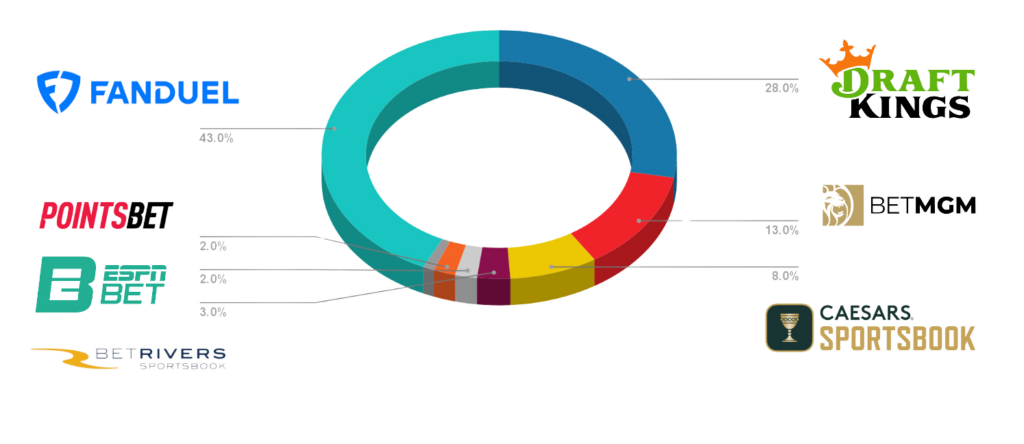
Bettors Preferred Applications
Media Partnerships and Entertainment Integration: A New Frontier
Technology is also transforming where and how users bet, particularly through partnerships between betting platforms and major media outlets. Real-time betting data is seamlessly integrated into sports broadcasts, allowing users to place live bets while watching games. These collaborations are creating more immersive viewing experiences, blending sports entertainment with betting in previously unimaginable ways.
Platforms like DraftKings and FanDuel have partnered with major broadcasters to deliver real-time betting options during live sports events. Media and sports betting convergence creates powerful new engagement tools, especially among younger, tech-savvy audiences. As these partnerships expand, the lines between sports betting and entertainment will continue to blur, offering companies the opportunity to innovate at the intersection of content and interactivity.
While partnerships with major broadcasters are creating immersive betting experiences, many gamblers are turning to alternative media sources like Reddit, Discord, and YouTube to gain insights and advice. These platforms have become thriving hubs where communities of bettors share real-time information, tips, and predictions, creating a new layer of interaction and community.
On platforms like Reddit, forums dedicated to specific sports or events allow users to exchange betting strategies. Meanwhile, Discord servers and YouTube channels have grown into cottage industries, where influencers and self-proclaimed experts sell betting advice and picks. This informal economy of betting tips has given rise to a new generation of content creators who monetize their expertise and build followings among tech-savvy bettors.
The shift toward alternative media diversifies where bettors get information and blurs the lines between social media interaction and sports betting strategy. As more users rely on these community-driven platforms for betting advice, betting companies can integrate these user-generated sources into their broader media strategies, further merging content, community, and betting.
Fintech and Blockchain: Reinventing the User Transaction Experience
As the sports betting market grows, so does the need for secure, fast, and reliable payment solutions. Fintech innovations such as mobile wallets, digital currencies, and blockchain technology are becoming critical components of the sports betting ecosystem. Blockchain, in particular, offers a new level of transparency and security, enabling tamper-proof transactions and ensuring compliance with regulatory standards.
The integration of blockchain technology allows platforms to safeguard user data and provide secure, seamless financial transactions. Whether users deposit funds, place bets, or withdraw winnings, blockchain ensures the integrity of each transaction.
Data Analytics: Deepening User Engagement
Data analytics is changing the sports betting industry by reimagining how sports books understand user behavior and deliver personalized experiences. The ability to gather and analyze vast amounts of data from mobile apps, social media, and betting patterns enables companies to optimize their platforms and refine their offerings. As a result, data-driven decisions are shaping the future of sports betting by improving user engagement, predicting trends, and enhancing product features.
- Personalized Betting Experiences:
Data analytics allows platforms to customize betting suggestions and promotions based on individual user preferences and behavior.
- Personalized Betting Experiences:
By analyzing historical betting data, platforms can forecast which games or events will drive the most user engagement and activity.
- Refining Product Features:
Data insights help platforms identify which features or promotions are most effective, allowing them to refine their offerings and boost retention.
- Optimizing Marketing Strategies:
Platforms use data from user interactions to create more targeted marketing campaigns that resonate with specific audience segments.
- Tracking User Behavior:
Tracking User Behavior: Analytics tools provide real-time insights into how users navigate the platform, helping companies optimize the overall user experience.
eSports and Virtual Sports: The New Betting Frontier
While traditional sports betting remains a dominant force, esports and virtual sports are quickly emerging as key players in the industry. eSports, in particular, is attracting a global audience, with platforms offering real-time betting on major titles such as “League of Legends” and “Counter-Strike.” AI-powered systems are helping to generate dynamic odds for these events, making eSports betting more interactive and accessible.
Gamers Worldwide
0
Virtual Sports
At the same time, virtual sports—AI-driven simulations of traditional sports—are becoming a popular alternative for users, offering continuous betting opportunities around the clock. Based on historical data, these virtual events allow for betting even when real-world sports are off-season or between games, opening up new revenue streams for platforms.
Expanding into esports and virtual sports presents an exciting opportunity to capture new audiences and diversify product offerings.
Looking to gain a competitive edge in the sports betting industry?
Purchase our Sports Betting Market Report 2024 and gain exclusive access to:
- Comprehensive analysis of the latest tech advancements in sports betting.
- Competitive breakdowns of the top innovative platforms shaping the future.
- Detailed profiles of how AI-driven platforms enhance user engagement.
- Key insights into emerging trends like esports and virtual sports.
- Expert analysis of how fintech and blockchain are revolutionizing the industry.
Don’t miss your chance to stay at the forefront of sports betting innovation. Get the full report today and equip yourself with the knowledge to drive technological leadership in this rapidly evolving market.