
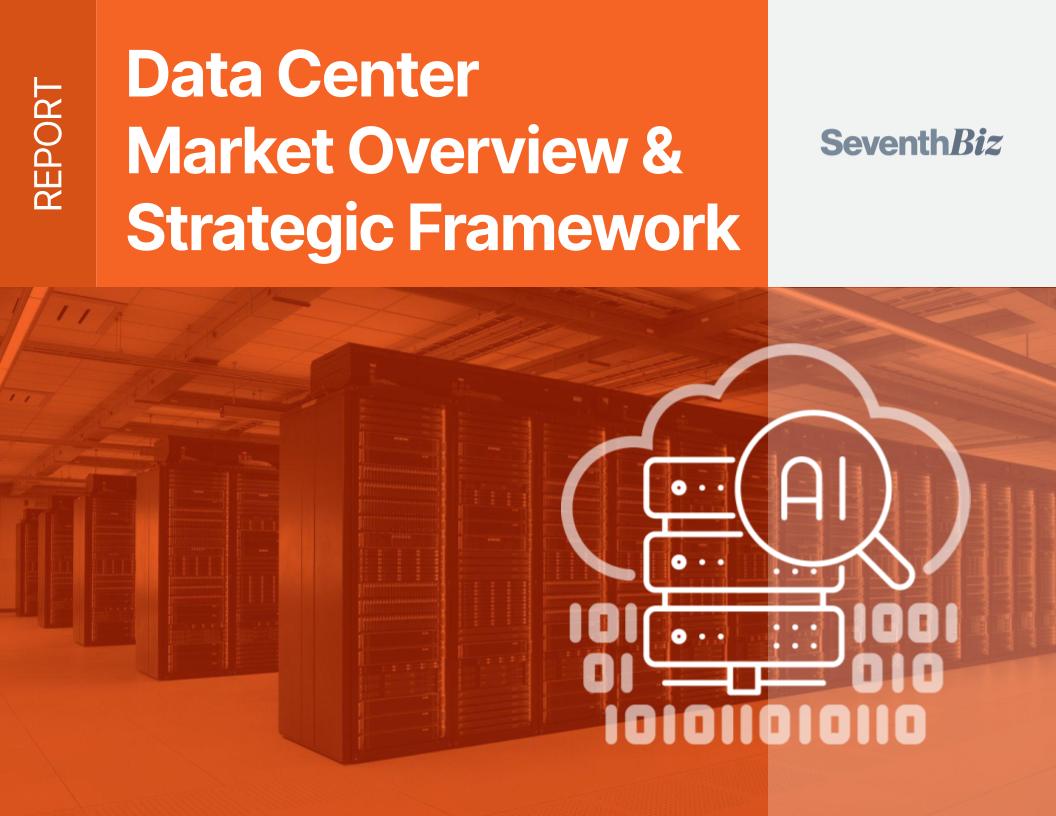
Why power, regulation, and infrastructure constraints—not demand—now determine where data center growth is actually possible.
$2,475
$2,475
Why power, regulation, and infrastructure constraints—not demand—now determine where data center growth is actually possible.
The Data Center Market Overview & Strategic Framework provides an investor-grade, decision-oriented analysis of the data center industry as it enters a constraint-driven growth phase shaped by AI workloads, power availability, and regulatory complexity.
Rather than treating the market as a single, unconstrained opportunity, the report reframes data center growth through the lens of constrained TAM—examining how grid access, permitting timelines, energy sourcing, cooling requirements, and community acceptance determine where demand can realistically be deployed.
Built for investors, developers, operators, utilities, and ecosystem partners, this report integrates market sizing, geographic differentiation, AI-driven infrastructure shifts, regulatory dynamics, and economic restructuring into a unified strategic framework. It explains why speed-to-power has become the primary competitive differentiator, how AI is redefining facility design and cost structures, and which regions and platforms are structurally positioned to scale.
For decision-makers evaluating capital allocation, site selection, or long-term positioning, this report offers a clear view of where data center growth is feasible—and where it is fundamentally constrained.
Market Reality & Opportunity Framing
AI as an Infrastructure Shock
From “Power to Build” to “License to Operate”
Constrained TAM & Geographic Differentiation
Economics in a Power-Constrained Market
Strategic Design & Execution
Long-Term Industry Structure
Amazon Web Services (AWS), Microsoft Azure, Google Cloud, Meta, Oracle, IBM, NVIDIA, Intel, AMD, Equinix, Digital Realty, CyrusOne, CoreSite, Iron Mountain, Switch, American Tower, DigitalBridge,Vertiv, Schneider Electric, Eaton, ABB, Siemens, Legrand, Fluor, Jacobs, DPR Construction, Turner Construction, Dominion Energy, Duke Energy, Xcel Energy, PG&E.
SeventhBiz is built by career researchers and investors. Our team includes former Harvard Business School researchers, advanced-degree–holding analysts (MBA, MSIS), and leaders who previously ran venture capital and private equity due-diligence teams. We have completed more than 2,000 research engagements for Fortune 500 companies and private equity clients, and our partners include former University of Texas McCombs School of Business researchers and business librarians.
We translate institutional-grade research rigor into clear, decision-ready market intelligence for investors, operators, and strategists.
On average our team has 20 years of experience in the industry.

The Data Center Market Overview & Strategic Framework provides an investor-grade, decision-oriented analysis of the data center industry as it enters a constraint-driven growth phase shaped by AI workloads, power availability, and regulatory complexity.
Rather than treating the market as a single, unconstrained opportunity, the report reframes data center growth through the lens of constrained TAM—examining how grid access, permitting timelines, energy sourcing, cooling requirements, and community acceptance determine where demand can realistically be deployed.
Built for investors, developers, operators, utilities, and ecosystem partners, this report integrates market sizing, geographic differentiation, AI-driven infrastructure shifts, regulatory dynamics, and economic restructuring into a unified strategic framework. It explains why speed-to-power has become the primary competitive differentiator, how AI is redefining facility design and cost structures, and which regions and platforms are structurally positioned to scale.
For decision-makers evaluating capital allocation, site selection, or long-term positioning, this report offers a clear view of where data center growth is feasible—and where it is fundamentally constrained.
Market Reality & Opportunity Framing
AI as an Infrastructure Shock
From “Power to Build” to “License to Operate”
Constrained TAM & Geographic Differentiation
Economics in a Power-Constrained Market
Strategic Design & Execution
Long-Term Industry Structure
Amazon Web Services (AWS), Microsoft Azure, Google Cloud, Meta, Oracle, IBM, NVIDIA, Intel, AMD, Equinix, Digital Realty, CyrusOne, CoreSite, Iron Mountain, Switch, American Tower, DigitalBridge,Vertiv, Schneider Electric, Eaton, ABB, Siemens, Legrand, Fluor, Jacobs, DPR Construction, Turner Construction, Dominion Energy, Duke Energy, Xcel Energy, PG&E.
SeventhBiz is built by career researchers and investors. Our team includes former Harvard Business School researchers, advanced-degree–holding analysts (MBA, MSIS), and leaders who previously ran venture capital and private equity due-diligence teams. We have completed more than 2,000 research engagements for Fortune 500 companies and private equity clients, and our partners include former University of Texas McCombs School of Business researchers and business librarians.
We translate institutional-grade research rigor into clear, decision-ready market intelligence for investors, operators, and strategists.
On average our team has 20 years of experience in the industry.