A strategic, infrastructure-grade analysis of how rising power density is reshaping data center thermal systems.
$4,875
$4,875
A strategic, infrastructure-grade analysis of how rising power density is reshaping data center thermal systems.
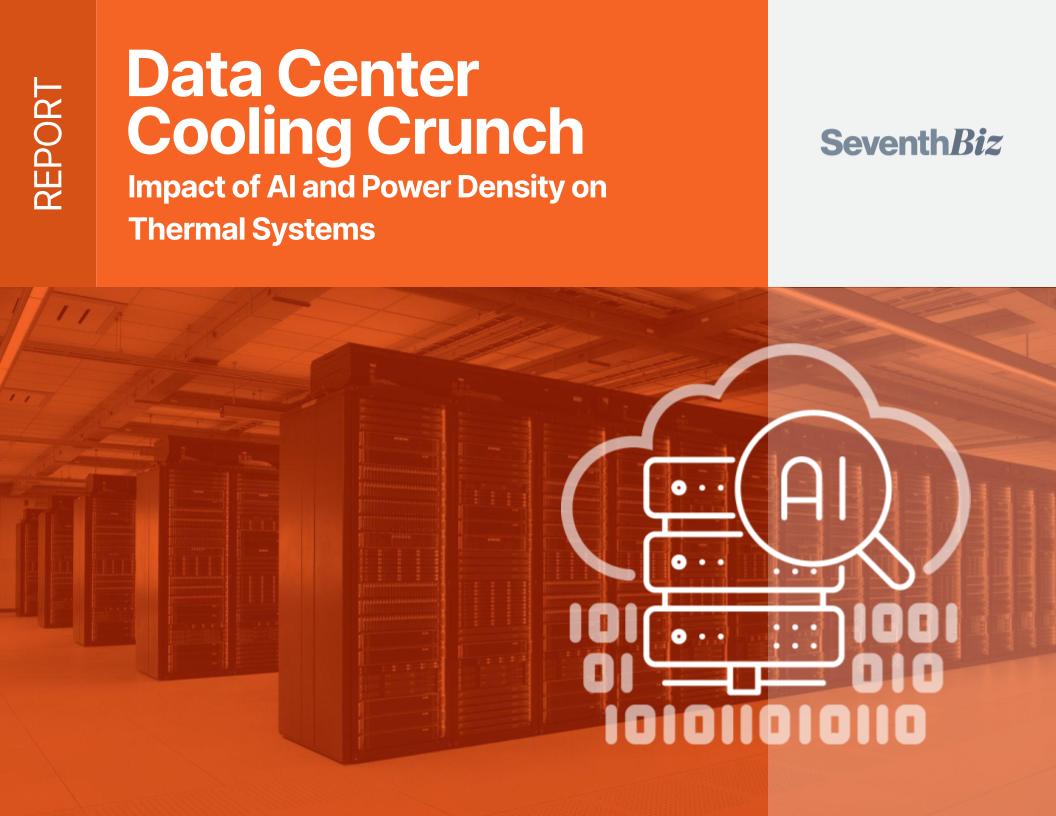
Data Center Cooling Crunch: Impact of AI and Power Density on Thermal Systems examines how AI-driven workloads are fundamentally changing the role of cooling in modern data centers—transforming it from a background facilities function into a capacity-defining layer of infrastructure.
As rack densities rise from historical norms of 5–20 kW toward 100+ kW and beyond, traditional air-based cooling architectures are reaching their physical and economic limits. This report analyzes how operators are responding through hybrid cooling designs, direct-to-chip liquid cooling, prefabricated thermal modules, and integrated power-and-cooling systems that enable higher density, faster deployment, and greater efficiency.
Grounded in management commentary and deployment realities across hyperscale, colocation, and enterprise environments, the report maps the full cooling ecosystem—from HVAC and precision cooling to liquid and immersion technologies—and explains how sustainability, water usage, regulatory pressure, and speed-to-market are reshaping thermal strategy.
Built for data center operators, infrastructure investors, equipment vendors, utilities, and engineering partners, Data Center Cooling Crunch provides a clear framework for evaluating cooling architectures, deployment trade-offs, and long-term positioning in an AI-driven infrastructure market where thermal performance increasingly determines how much compute can actually be deployed.
Purchasing this report also includes the Data Center Market Overview & Strategic Framework.
Clients purchasing two or more specialized reports typically consolidate into the Full Compendium for comprehensive coverage and long-term strategic reference.
Cooling as a Capacity Constraint
AI-Driven Density & Thermal Limits
Architecture Decisions: Air, Liquid, Hybrid, Immersion
Speed-to-Market & Deployment Strategy
Cooling Economics & KPIs
Sustainability, Water Use & Regulation
Vendor & Ecosystem Dynamics
Long-Term Cooling Strategy
Vertiv, Schneider Electric, Eaton, ABB, Siemens, Legrand, NVIDIA, Intel, AMD, Submer, LiquidStack, Green Revolution Cooling (GRC), Equinix, Digital Realty, CyrusOne, Amazon Web Services (AWS), Microsoft Azure, Google Cloud, Meta.
SeventhBiz is built by career researchers and investors. Our team includes former Harvard Business School researchers, advanced-degree–holding analysts (MBA, MSIS), and leaders who previously ran venture capital and private equity due-diligence teams. We have completed more than 2,000 research engagements for Fortune 500 companies and private equity clients, and our partners include former University of Texas McCombs School of Business researchers and business librarians.
We translate institutional-grade research rigor into clear, decision-ready market intelligence for investors, operators, and strategists.
On average our team has 20 years of experience in the industry.
Data Center Cooling Crunch: Impact of AI and Power Density on Thermal Systems examines how AI-driven workloads are fundamentally changing the role of cooling in modern data centers—transforming it from a background facilities function into a capacity-defining layer of infrastructure.
As rack densities rise from historical norms of 5–20 kW toward 100+ kW and beyond, traditional air-based cooling architectures are reaching their physical and economic limits. This report analyzes how operators are responding through hybrid cooling designs, direct-to-chip liquid cooling, prefabricated thermal modules, and integrated power-and-cooling systems that enable higher density, faster deployment, and greater efficiency.
Grounded in management commentary and deployment realities across hyperscale, colocation, and enterprise environments, the report maps the full cooling ecosystem—from HVAC and precision cooling to liquid and immersion technologies—and explains how sustainability, water usage, regulatory pressure, and speed-to-market are reshaping thermal strategy.
Built for data center operators, infrastructure investors, equipment vendors, utilities, and engineering partners, Data Center Cooling Crunch provides a clear framework for evaluating cooling architectures, deployment trade-offs, and long-term positioning in an AI-driven infrastructure market where thermal performance increasingly determines how much compute can actually be deployed.
Purchasing this report also includes the Data Center Market Overview & Strategic Framework.
Clients purchasing two or more specialized reports typically consolidate into the Full Compendium for comprehensive coverage and long-term strategic reference.
Cooling as a Capacity Constraint
AI-Driven Density & Thermal Limits
Architecture Decisions: Air, Liquid, Hybrid, Immersion
Speed-to-Market & Deployment Strategy
Cooling Economics & KPIs
Sustainability, Water Use & Regulation
Vendor & Ecosystem Dynamics
Long-Term Cooling Strategy
Vertiv, Schneider Electric, Eaton, ABB, Siemens, Legrand, NVIDIA, Intel, AMD, Submer, LiquidStack, Green Revolution Cooling (GRC), Equinix, Digital Realty, CyrusOne, Amazon Web Services (AWS), Microsoft Azure, Google Cloud, Meta.
SeventhBiz is built by career researchers and investors. Our team includes former Harvard Business School researchers, advanced-degree–holding analysts (MBA, MSIS), and leaders who previously ran venture capital and private equity due-diligence teams. We have completed more than 2,000 research engagements for Fortune 500 companies and private equity clients, and our partners include former University of Texas McCombs School of Business researchers and business librarians.
We translate institutional-grade research rigor into clear, decision-ready market intelligence for investors, operators, and strategists.
On average our team has 20 years of experience in the industry.